> ## Documentation Index
> Fetch the complete documentation index at: https://docs.lerian.studio/llms.txt
> Use this file to discover all available pages before exploring further.
# Concepts map
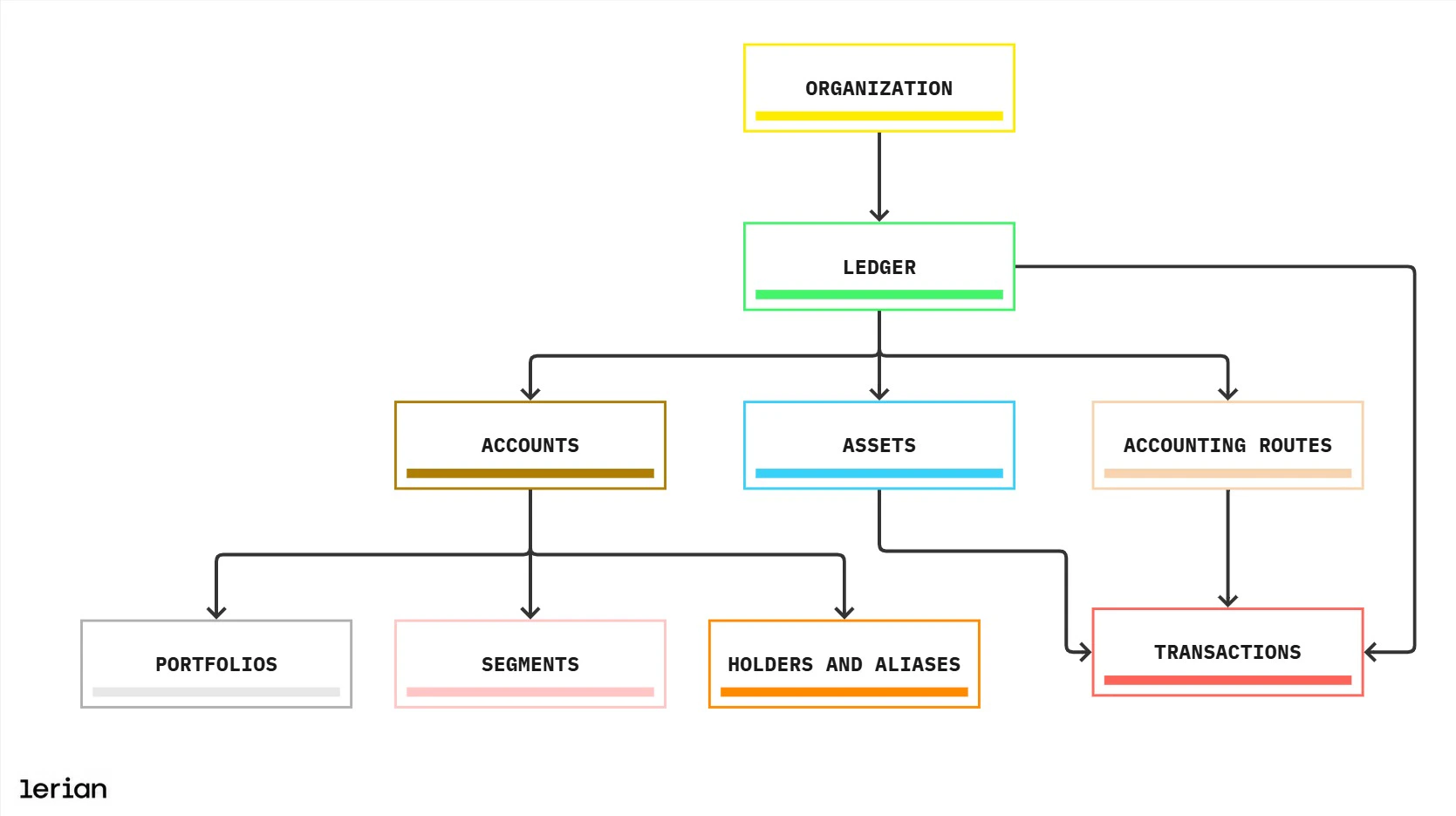
> Understand how Organizations, Ledgers, Assets, Accounts, Routes, and Transactions relate before configuring the Midaz Module.
The Midaz Module uses a small set of core objects, but they depend on each other in a strict way. If the user does not understand that structure, the UI feels arbitrary. This page is the shortest path to the mental model.
## Core hierarchy
***
 ### What each object means
***
| Object | What it represents | Why it exists first or later |
| ------------------ | ------------------------------------------------------------------------ | -------------------------------------------------------------------------------- |
| `Organization` | The legal or operational owner of the setup | It is the top-level boundary. Nothing below exists without it. |
| `Ledger` | The accounting environment where balances and movements are recorded | It groups the structure that a team will operate day to day. |
| `Asset` | The unit of value moved in the ledger, such as `BRL` or `USD` | Accounts and transactions depend on it. |
| `Account` | A balance container that can send or receive value | Transactions happen between accounts. |
| `Account Type` | A structural classification such as `checking`, `treasury`, or `expense` | It becomes important when the ledger enforces type validation. |
| `Portfolio` | A grouping of accounts, often by customer or wallet structure | Useful for reporting and organization, but not a prerequisite for every account. |
| `Segment` | A classification tag for accounts, such as department, region, or tier | Useful when the business needs slicing or policy grouping. |
| `Holder` | The person or entity that owns accounts in CRM flows | Needed when account ownership matters operationally. |
| `Alias` | A human-readable identifier used to find or refer to an account | Especially important in transaction creation. |
| `Accounting Route` | The rule set that validates participants and defines posting behavior | It turns a movement request into a consistent accounting pattern. |
| `Transaction` | The actual balance movement recorded in the ledger | It is the output of the whole setup. |
## How a transaction actually depends on prior setup
***
### What each object means
***
| Object | What it represents | Why it exists first or later |
| ------------------ | ------------------------------------------------------------------------ | -------------------------------------------------------------------------------- |
| `Organization` | The legal or operational owner of the setup | It is the top-level boundary. Nothing below exists without it. |
| `Ledger` | The accounting environment where balances and movements are recorded | It groups the structure that a team will operate day to day. |
| `Asset` | The unit of value moved in the ledger, such as `BRL` or `USD` | Accounts and transactions depend on it. |
| `Account` | A balance container that can send or receive value | Transactions happen between accounts. |
| `Account Type` | A structural classification such as `checking`, `treasury`, or `expense` | It becomes important when the ledger enforces type validation. |
| `Portfolio` | A grouping of accounts, often by customer or wallet structure | Useful for reporting and organization, but not a prerequisite for every account. |
| `Segment` | A classification tag for accounts, such as department, region, or tier | Useful when the business needs slicing or policy grouping. |
| `Holder` | The person or entity that owns accounts in CRM flows | Needed when account ownership matters operationally. |
| `Alias` | A human-readable identifier used to find or refer to an account | Especially important in transaction creation. |
| `Accounting Route` | The rule set that validates participants and defines posting behavior | It turns a movement request into a consistent accounting pattern. |
| `Transaction` | The actual balance movement recorded in the ledger | It is the output of the whole setup. |
## How a transaction actually depends on prior setup
***
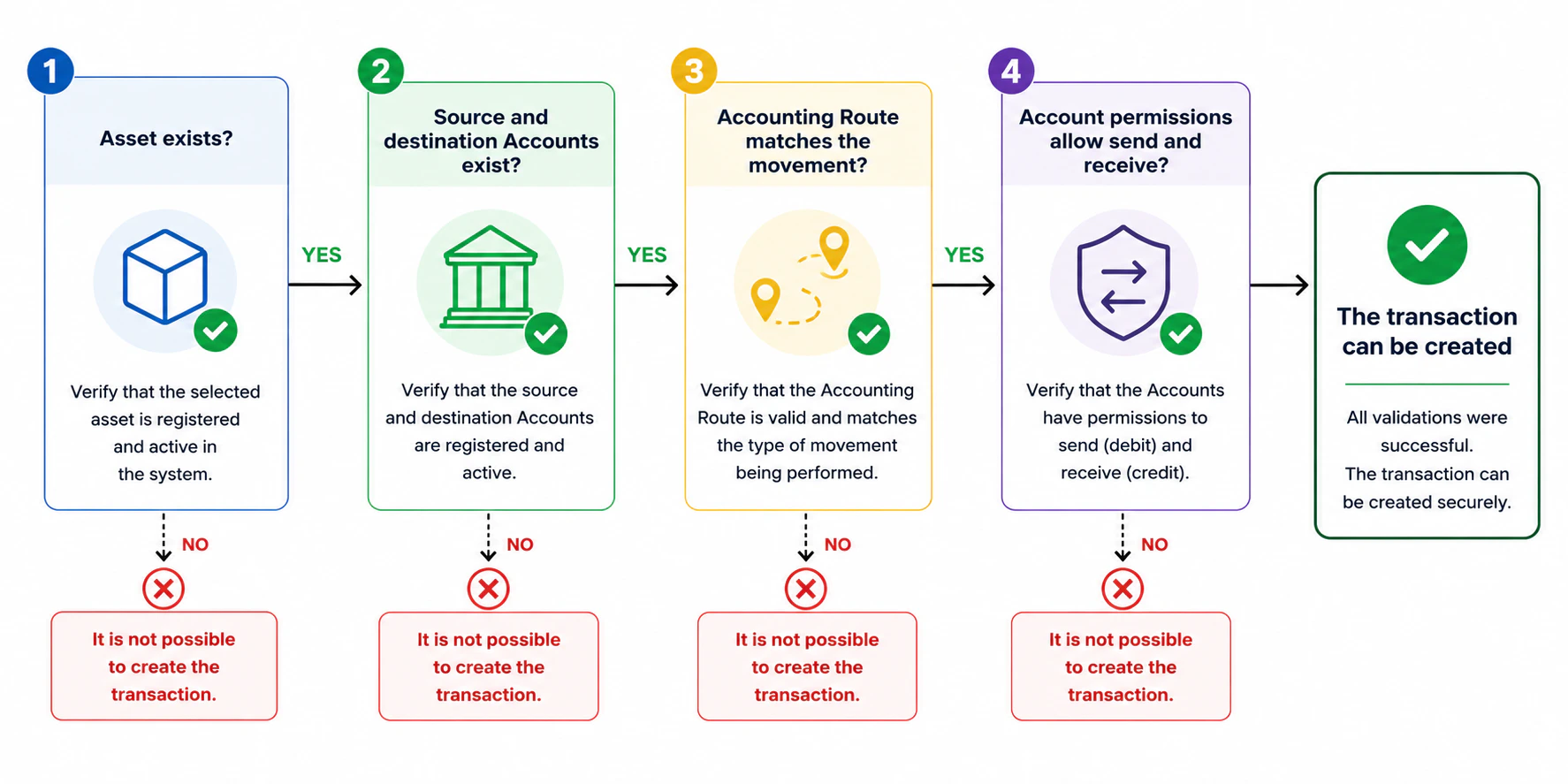 If any one of these prerequisites is missing, the transaction page becomes confusing because the operator is trying to complete a movement that the ledger model still cannot support.
## Practical reading of the UI
***
Use this interpretation when guiding users:
• `Foundation` defines where the system lives: Organization, Ledger, Asset.
• `Accounting` defines the rules of participation and posting: Account Types and Accounting Routes.
• `Accounts` defines who holds balances and how they are classified: Accounts, Holders, Aliases, Segments, Portfolios.
• `Transactions` is where the configured structure is exercised.
• `Plugins` extend the model after the core behavior is already working.
## When users usually get lost
***
The Account is the balance container. The Holder is the owner identity in CRM flows. The Alias is just a human-friendly way to reference the Account.
Account Type controls structural classification and validation. Segment is a grouping label. Portfolio is an operational grouping of accounts, often around a wallet or customer structure.
The Route is the reusable rule. The Transaction is the individual movement that follows the rule.
Almost every object below it is ledger-scoped. Users who treat the ledger as a cosmetic container usually misconfigure accounts and routes later.
Pair this page with [Setup path](/en/lerian-console/midaz-console/midaz-console-setup-path) when onboarding new users. One page explains the model; the other explains the order.
If any one of these prerequisites is missing, the transaction page becomes confusing because the operator is trying to complete a movement that the ledger model still cannot support.
## Practical reading of the UI
***
Use this interpretation when guiding users:
• `Foundation` defines where the system lives: Organization, Ledger, Asset.
• `Accounting` defines the rules of participation and posting: Account Types and Accounting Routes.
• `Accounts` defines who holds balances and how they are classified: Accounts, Holders, Aliases, Segments, Portfolios.
• `Transactions` is where the configured structure is exercised.
• `Plugins` extend the model after the core behavior is already working.
## When users usually get lost
***
The Account is the balance container. The Holder is the owner identity in CRM flows. The Alias is just a human-friendly way to reference the Account.
Account Type controls structural classification and validation. Segment is a grouping label. Portfolio is an operational grouping of accounts, often around a wallet or customer structure.
The Route is the reusable rule. The Transaction is the individual movement that follows the rule.
Almost every object below it is ledger-scoped. Users who treat the ledger as a cosmetic container usually misconfigure accounts and routes later.
Pair this page with [Setup path](/en/lerian-console/midaz-console/midaz-console-setup-path) when onboarding new users. One page explains the model; the other explains the order.