

The challenge for indirect participants
Indirect Pix institutions depend on a Direct Participant to reach BACEN’s Pix infrastructure. This model reduces regulatory overhead, but introduces a different set of technical and operational barriers:
- custom middleware to translate messages
- complex integration flows with direct providers
- strict orchestration requirements
- regulatory expectations around DICT, transaction flows, and fraud prevention
- high-availability infrastructure for real-time processing
- compliance constraints across multiple actors
The Lerian solution
The Indirect Pix Plugin provides a unified processing layer between the client’s core systems and their Direct Participant. It handles:
- protocol translation
- message routing
- transaction orchestration
- DICT-related flows (key validation, lookup, and dispute signaling)
- reconciliation and event propagation
- regulatory-aligned validations
Key benefits
- Accelerated Integration Eliminates custom middleware and cuts integration effort by 70%+.
- Native Midaz Integration Real-time ledger reads, account validations, and postings with zero custom mapping.
- Aligned with Lerian Ecosystem Seamless connections to Reporter, Matcher, Flowker, Fee, and Access Manager.
- Direct Provider Connectivity Built-in support for direct participant APIs and event handling.
- Regulatory Compliance Pre-configured workflows aligned with BACEN rules for indirect participants.
- Enterprise Security & Observability Full auditability, event trails, access control, and resilience guarantees.
- Scalable Architecture Designed to support high-volume, low-latency Pix operations.
Functional architecture
The Indirect Pix Plugin is composed of four core modules. Each module implements a specific domain of Pix operations while preserving cohesion across the full Pix lifecycle.
DICT Module
Manages Pix keys and DICT-driven workflows.- Entries API – Register, update, delete, and query Pix keys across all formats.
- Claims API & Events – Full port-out/port-in lifecycle with validation and notifications.
- Claim Resolution Worker – Processes claim windows, timeouts, and decisions.
- Reconciliation Worker – Continuous DICT synchronization with automatic conflict resolution.
QR Code Module
Full support for Pix QR Code generation, decoding, and orchestration.- Static QR Code API – Reusable payment codes.
- Immediate Dynamic QR Code API – Single-use, time-sensitive QR Codes with pre-defined amounts.
- Due Date Dynamic QR Code API – Scheduled payments with due dates, discounts, fines, and fees.
- Decode API – Parses payloads and validates code structure.
Transactions Module
Core payment engine for outbound, inbound, and refund operations.- Cash-Out API & Events – Ledger validation, authorization, execution, and status lifecycle.
- Cash-In Events – Process incoming Pix and update ledger balances.
- Refund APIs (In/Out) – Full and partial refunds for both directions.
- Resilience Worker – Automatic retry, recovery, and eventual consistency for pending operations.
MED Module (Regulatory Disputes & Fraud Signaling)
Implements Central Bank–mandated dispute and fraud signaling workflows, as defined by BACEN and enforced through DICT-related processes — not real-time transactional antifraud.- Infraction Report API & Events – Submit and track regulatory infraction reports linked to Pix transactions, following BACEN-defined MED workflows.
- Refund Request API & Events (RDR) – Handle fraud-related refund requests initiated under MED rules.
- Automatic Refund Analysis Worker – Automates decisioning for MED and RDR cases based on regulatory criteria and evidence timelines.
- Antifraud Signaling API – Manage fraud markers, classifications, and statistics for regulatory signaling and dispute resolution, not for transactional blocking.
Lerian ecosystem integrations
Native integrations
- Midaz Ledger Real-time balance validation, double-entry posting, and operation routing.
- CRM Plugin Customer and bank-account metadata for Pix orchestration flows.
- Fee Engine (optional) Automated fee calculation and posting.
- Access Manager (optional) Identity, credentials, and access control for Pix applications.
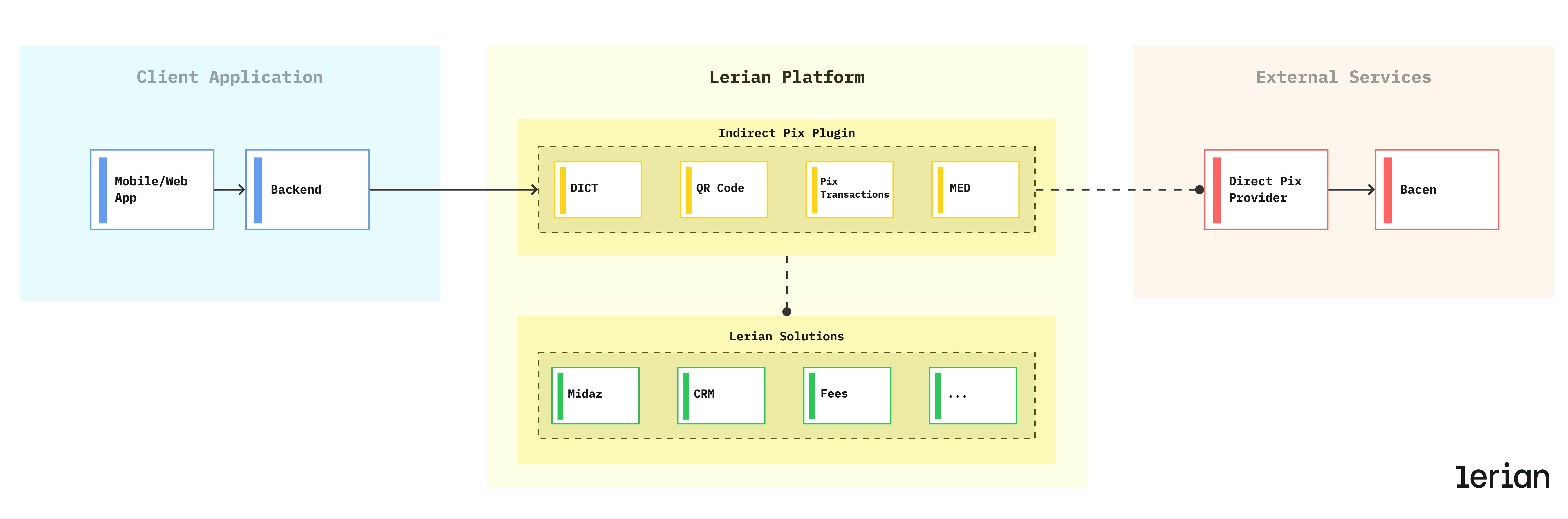
Downstream integrations
- Reporter — Regulatory reporting engine that consumes Pix events for BACEN filings.
- Matcher — Multi-layer reconciliation across ledger, plugin state, and provider instructions.
- Flowker — Orchestration engine for custom flows and business rules.
Requirements
To operate as an indirect participant using the Indirect Pix Plugin, clients must meet the following prerequisites:
Regulatory & Contractual
- Be a financial or payment institution registered as an indirect participant in the Pix arrangement.
- Have an active contract with a Direct Participant connected to the Lerian platform.
Technical Infrastructure
- Use Midaz as the core ledger.
- Store customer and account information in the CRM Plugin.
- Consume APIs through Lerian’s API Gateway.
- Maintain compatible versions of Midaz, CRM, and the Pix Plugin.
- Operate on self-managed cloud (BYOC) or on-premise infrastructure.