

- A Direct Participant, or
- A certified PSTI + SPI Gateway hired by the institution.
1. What the Pix Plugin provides
The Pix Plugin delivers a complete Pix orchestration layer, handling the full business lifecycle of Pix operations:
- Cash-out and cash-in flows (pacs.008, 002 e 004 orchestration)
- Pix Automático and payer’s journey
- Intra-ledger Pix transfers (trck.002 orchestration)
- Pix key management (DICT logic + claims)
- Static & dynamic QR Code generation
- MED lifecycle orchestration
- Webhooks, event processing, background workers
- Full Midaz integration (mandatory for Indirect Pix and optional, but optimized, for Direct Pix)
- BYOC (Bring Your Own Cloud)
- On-premise
2. Connection models
The Pix Plugin supports all Pix participation models defined by BACEN — but always through a regulated connectivity provider.
Indirect Pix
You connect to Pix via a Direct Participant’s infrastructure. Ideal when the institution does not maintain SPI/DICT connectivity.Direct Pix (via PSTI + Gateway)
You operate Pix directly, but rely on a certified PSTI + SPI/DICT gateway for BACEN network communication. This model combines autonomy with outsourced regulated connectivity.Direct Pix (full)
You maintain your own SPI/DICT connectivity and all regulated channels. Requires the highest operational maturity and infrastructure capacity.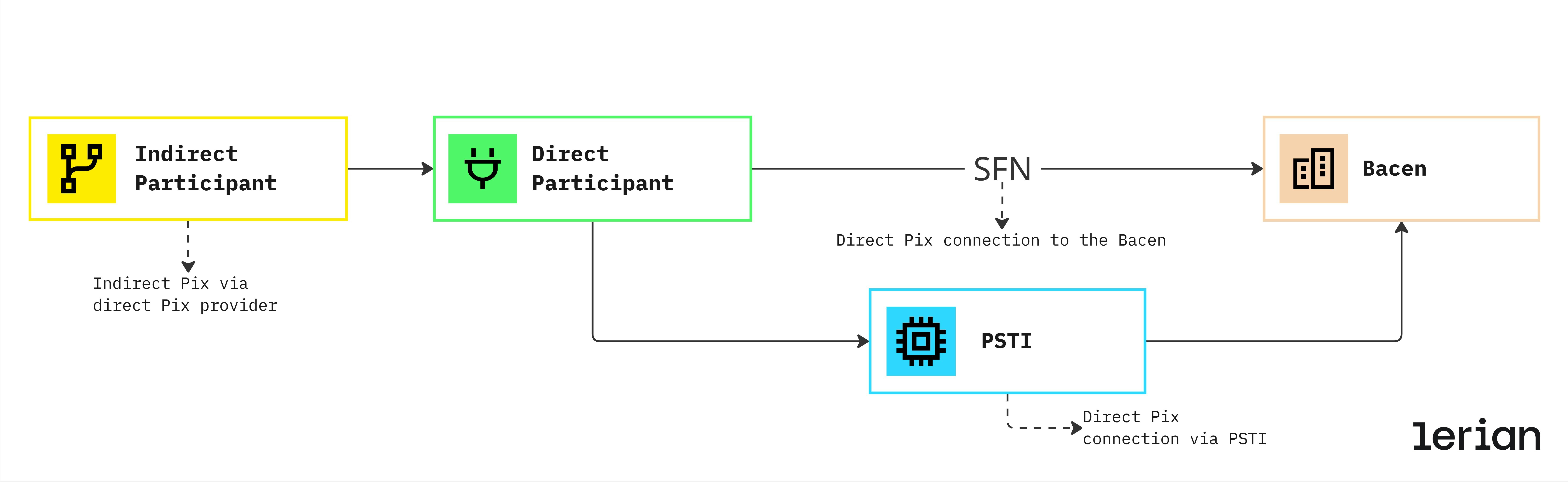
3. Integrations in the Lerian ecosystem
The Pix Plugin is ledger-agnostic, but provides native, highly optimized integration with Midaz as the core ledger. This simplifies:
- Account validation
- Balance checks
- Debit/credit posting
- Routing
- Limit enforcement (only for Direct Pix)
- Reconciliation (only dor Direct Pix)
- Business rules (fees, authorizations, antifraud triggers)
- Matcher — reconciliation & identity matching
- Flowker — workflow orchestration
- Reporter — regulatory & COSIF-ready reporting
- Tracer — observability & distributed tracing
4. Target audience
The Pix Plugin is designed for institutions that:
- Participate in the Pix arrangement
- Maintain their own ledger (Midaz or another system)
- Control customer accounts and balances
- Own a valid ISPB
- Manage their own production environments
- Prefer autonomy over BaaS-style shared infrastructure
- Dedicated environments
- High-performance processing
- Custom business rules
- Compliance-ready architecture
- Reduced reliance on external PSPs
5. Requirements to operate Pix with the Plugin
Institutions must:
- Possess a valid ISPB.
- Contract a Direct Participant or a PSTI + SPI Gateway that offers native integration with BACEN’s Pix infrastructure, depending on the participation model.
- Operate their own cloud/on-prem environment.
- Maintain full control of the ledger.
- Have DevOps and SRE readiness.
- Manage their own security, redundancy, and observability.
- Regulated connectivity (via PSTI or Direct Participant)
- Operational continuity
- Compliance and audits
- Infrastructure provisioning
6. Advantages of using the Pix Plugin
Institutions benefit from:
Full control
- Run everything in your infrastructure
- Define routing, rules, limits, policies
- No shared environments
Security & autonomy
- Your own IAM policies and governance
- Complete data-plane and infra isolation
Economic efficiency
- Infrastructure sized for your own demand
- No reliance on multi-layer intermediaries
Ecosystem-native integrations
- Midaz
- Matcher
- Flowker
- Reporter
- Tracer
Customization
- Extend or modify business logic as needed
- Adapt to regulatory updates at your pace
7. Trade-offs and challenges
While the Pix Plugin offers maximum control, it comes with responsibilities.
Requires technical maturity
Institutions need DevOps, observability, and operational management capabilities.Requires governance discipline
Security, uptime, and compliance must be maintained internally.More configuration upfront
Flexibility means more orchestration and parameterization at the beginning.Operational responsibility
The institution manages updates, patches, and continuity plans. This model is best suited for institutions seeking autonomy, scalability, and long-term cost optimization.8. How the Pix Plugin works inside the Lerian architecture
In all connection models, the plugin acts as the Pix engine inside your infrastructure:
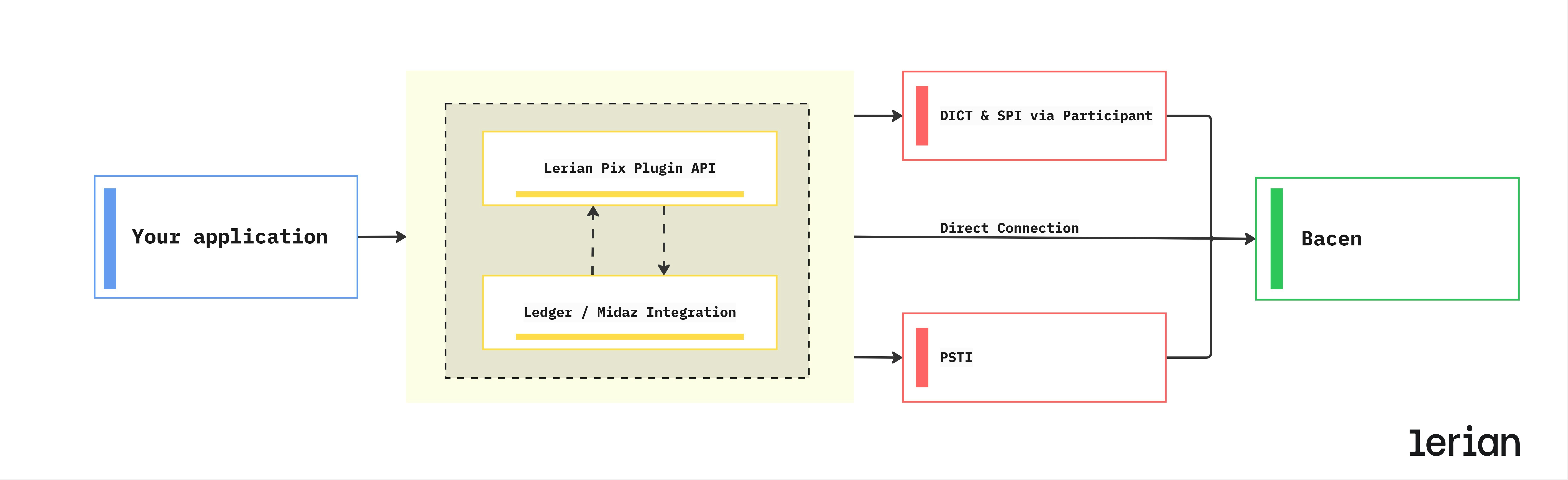
- Transaction lifecycle
- DICT logic
- MED flows
- Refund orchestration
- Real-time validations
- Background jobs
- Event processing
- Webhooks
- Compliance logic
- SPI messaging
- DICT communication
- RSFN channels
- Cryptographic infrastructure
- Network-level compliance